
A closed-door White House meeting may decide whether stablecoins can pay yield. The decision could shift up to $500B in bank deposits.
Senior banking and crypto executives will meet at the White House on Feb 2 as lawmakers try to break a deadlock over stablecoin rules. The stakes are high.
Analysts at Standard Chartered estimate that stablecoins could pull as much as $500B out of traditional bank deposits by 2028 if yields remain allowed.
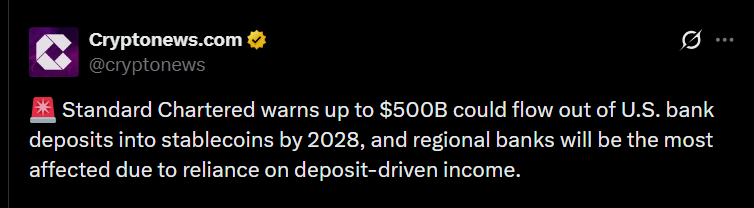
That projection has pushed stablecoin rewards to the center of the policy debate.
RECOMMENDED: Former CFTC Chairman: Stablecoins Will Replace Failed Currencies
Why Stablecoin Yields Are The Core Issue
Banks argue that stablecoin rewards create a direct alternative to savings accounts. Unlike deposits, stablecoins sit outside traditional insurance systems. Regulators worry that fast-moving digital dollars could leave banks exposed during periods of stress.
Crypto firms, on the other hand, argue that yields help users keep pace with inflation and make on-chain payments more efficient.
Data shows that with short-term rates still elevated, even modest stablecoin rewards compete with bank accounts. If stablecoins capture hundreds of billions in deposits, banks may need to tighten lending or raise rates to keep funds in-house.
RECOMMENDED: SEC Drops Gemini Earn Lawsuit, Ending A Long Legal Fight
Who Is At The Table And Why Now?
The February 2 meeting will bring together major U.S. banks, leading crypto firms, and industry groups. This comes at a time when lawmakers are struggling to move forward with stablecoin legislation, including the stalled CLARITY Act, which has hit a deadlock in the Senate.
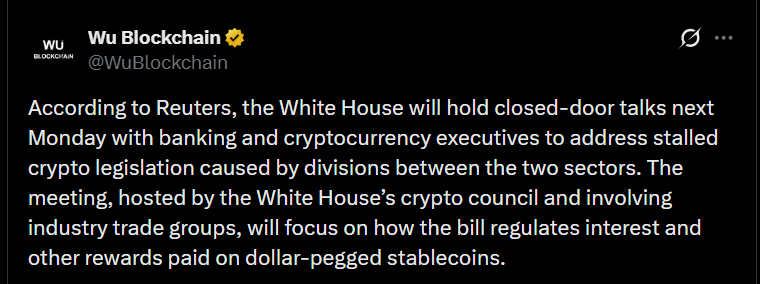
Without a compromise soon, the bill risks being pushed into next year. That would leave stablecoin issuers, investors, and users stuck in regulatory uncertainty, unsure what will be allowed and what will not.
Policymakers want clarity, and this meeting is an attempt to find common ground before the political window narrows.
RECOMMENDED: Crypto Cases Tied To President Trump Are Dropped
Possible Outcomes And Market Signals
One possible outcome is a middle-ground approach that allows capped or tightly regulated yields. This could ease bank concerns while still letting stablecoins remain competitive and useful.
Such a deal could also open the door to new, regulated yield products that attract capital without undermining financial stability.
A full ban on stablecoin yields might protect bank deposits in the short term, but could push yield-paying stablecoins outside the U.S., where oversight is weaker. Innovation would likely continue elsewhere, leaving American regulators with less visibility and control.
ALSO READ: Stablecoins Take Center Stage: What New Global Rules Could Mean for Your Wallet
Conclusion
This meeting will influence where hundreds of billions of dollars sit in the financial system. The outcome will shape how Americans save, spend, and move dollars in a digital economy.
Wondering which crypto to focus on right now?
Our premium members already know.
Before you invest, you’re going to want to read our next premium crypto alert which will be published in the coming days. We will reveal key crypto assets to consider in 2026 with explosive potential.
Since 2017, InvestingHaven’s blockchain research service has been guiding investors through both bull runs and crypto winters.