
Iran’s Central bank allegedly bypassed sanctions with USDT.
Blockchain investigators traced large stablecoin flows to state-linked wallets, revealing how digital dollars can move across borders quietly.
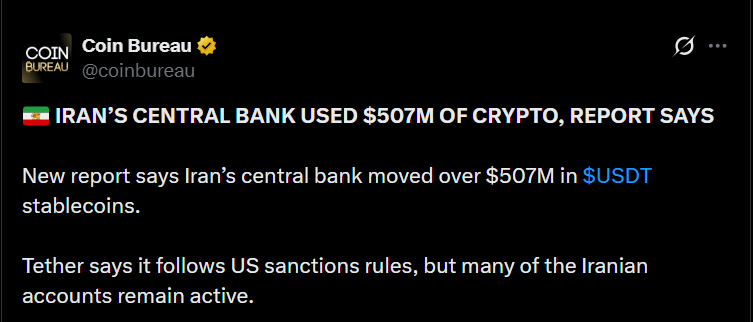
Blockchain investigators say Iran’s central bank may have used hundreds of millions of dollars in USDT stablecoins to move money around international sanctions.
Their findings point to a coordinated effort rather than random crypto activity.
According to analysts, about $507 million in USDT was traced to wallets linked to Iran’s central bank.
A separate review identified around 187 connected wallets, with an estimated $1 billion flowing through UK-registered crypto platforms between 2023 and 2025.
The transactions were fast, repetitive, and structured in similar ways; patterns that usually suggest organized financial operations rather than everyday trading.
RECOMMENDED: Did The U.S Steal $15B Bitcoin From A Chinese Scam King? Here Is The Truth
What Investigators Saw on the Blockchain
Blockchain analysts tracked groups of wallets that moved large amounts of USDT in short bursts.
Many transactions followed the same routes, often jumping between the Tron and Ethereum networks before ending up at crypto exchanges.
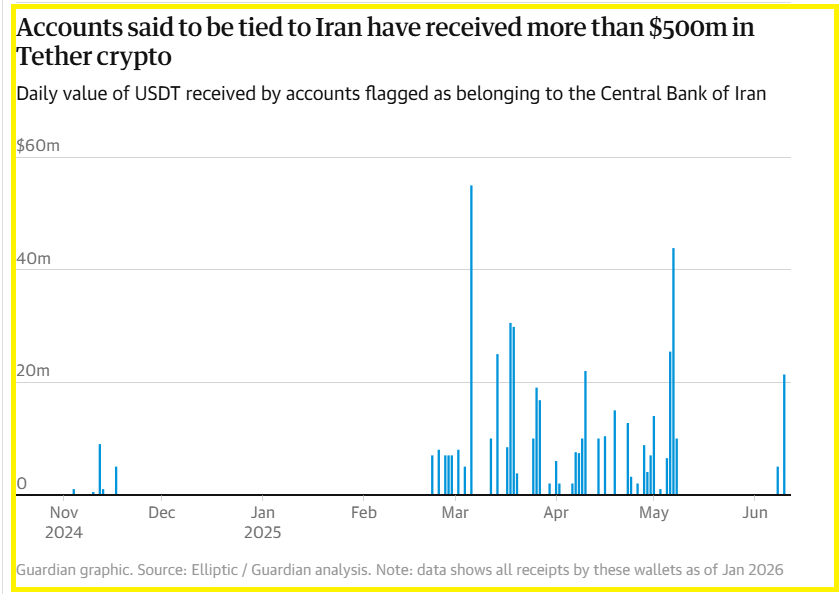
The size, timing, and structure of these transfers closely matched patterns seen in international trade settlements, not typical retail crypto use.
In 2025, similar findings led Tether to freeze several Iranian-linked wallets, showing that stablecoin issuers can step in once suspicious links are clearly identified.
RECOMMENDED: Tether Freezes $182 Million In Suspected Illicit Funds
How the Money Allegedly Moved
Investigators say the system combined crypto with traditional finance.
Payments for goods were converted into USDT and then split across many wallets.
The funds were moved through multiple blockchains and simple obfuscation methods to make tracking harder.
Eventually, the stablecoins reached exchanges with weaker compliance checks.
From there, over-the-counter (OTC) desks and intermediaries converted the USDT into fiat currency and moved the value offshore.
Speed played a key role, reducing the risk of wallet freezes before the funds exited the system.
ALSO READ: Trump Tariffs Spark Overnight Crypto Bloodbath – $100B Wiped
Why This Matters for Sanctions and Crypto Regulation
These findings raise serious concerns for regulators and stablecoin issuers.
Stablecoins are popular because they settle quickly and hold steady value, but they can also replicate the dollar system without the same level of oversight.
If governments can move hundreds of millions this way, regulators may push for stricter exchange monitoring, faster wallet freezes, and tougher penalties for platforms that ignore warning signs.
READ NEXT : Crypto Cases Tied To President Trump Are Dropped
Conclusion
The alleged transactions show how stablecoins can exploit gaps between crypto networks and traditional finance.
How regulators close those gaps will likely define the next phase of global crypto oversight.
Wondering which crypto to focus on right now?
Since 2017, InvestingHaven’s blockchain research service has been guiding investors through both bull runs and crypto winters.
In just a few days, we will publish our next Premium Crypto Alert, which will reveal key cryptocurrencies with explosive potential. This is one that you’re going to want to read.